
It is to be seen if SBI under Setty, who will have a three-year term, can ride the economic cycle to take SBI to new heights, navigating some of these challenges.

With the stock coming under pressure, the MF holding value could have dropped to Rs 50 billion, back-of-the-envelope calculations show.
Talks of a merger between HDFC Bank and parent HDFC Ltd had gained steam nearly eight years ago, when the Reserve Bank of India allowed banks to issue long-term bonds to fund infrastructure and affordable housing. At that time, key executives at both entities denied any such proposal. And today, the merger has been officially announced by the two players.

The central bank might raise repo and reverse repo rates by 25 basis points each, they said. Still, RBI action would be conditional on its ensuring sufficient liquidity in the banking system.

Edtech company Byju's parent Think & Learn will challenge the National Company Law Tribunal's (NCLT's) order on insolvency proceedings and may approach the National Company Law Appellate Tribunal (NCLAT) in the next few days, a source claimed. With the NCLT appointing Pankaj Srivastava as the interim resolution professional (IRP), time is running out for Byju's as the committee of creditors (CoC) begins to be formed.

Bank of India will not resort to panic selling and is open to offer funds to brokers needing additional liquidity in the face of the stock market mayhem, a top bank official said.

The primary market is expected to remain vibrant, with at least 10 companies, including supermart major Vishal Mega Mart and Blackstone-owned diamond grading firm International Gemmological Institute (India) Ltd expected to raise a combined Rs 20,000 crore in the next month, merchant bankers said. Education-focused NBFC Avanse Financial Services, TPG Capital-backed Sai Life Sciences, hospital chain operator Paras Healthcare, and investment bank DAM Capital Advisors are also among the companies planning to launch their IPOs in December, they added. The companies aim to raise a total of Rs 20,000 crore through their public offerings.
The central bank's policy focus has shifted from reviving economic growth to defending a rupee that hit a record low of 61.21 to the dollar on July 8, when it was down more than 9 per cent since the start of the year.

Once a stock market darling, the jewellery chain heads for liquidation.

'Credit card debt comes with high interest cost and stringent penalties.' 'If you do not repay on time, the costs balloon.'

The Reserve Bank of India (RBI) has identified "climate shocks" as a risk to food inflation rates and overall price rise while stating that the outlook for the country's economic growth remains bright. In its Annual Report for 2023-24, released on Thursday, the central bank said easing supply-chain pressures, broad-based softening in core inflation, and early indications of an above-normal southwest monsoon meant well for the inflation outlook in 2024-25. "The increasing incidence of climate shocks, however, imparts considerable uncertainty to the food inflation and overall inflation outlook," said the RBI while noting headline inflation moderated by 1.3 percentage points on an annual average basis to 5.4 per cent in 2023-24.

The opposition party questioned why the government took five years after the liquidation proceedings of ABG Shipyard to lodge an FIR in connection with the alleged duping of 28 banks.

Lifting of deposit withdrawal moratorium on March 18 could open flood gates and will require a calibrated approach along with active support and signaling from the RBI, government and investor banks.

The concept of gold as an asset capable of getting anytime money is evaporating.

New investors should gradually build a 5 to 10 per cent allocation to gold.

The problem for the NBFC sector is the funding inertia by banks and not lack of funds.

'Investors can consider staying invested in long duration products as there is a possibility of rate cuts in the near term.' Positive macros - lower inflation, high forex reserves and favourable demand-supply dynamics for government bonds - make a strong case for rate cuts from December, says Devang Shah, head of fixed income, Axis Mutual Fund. In an interview with Abhishek Kumar in Mumbai, Shah says this view may not hold true if commodity prices go up sharply.

The country's largest lender State Bank of India (SBI) will revamp its banking application (app) YONO and position it as a complete digital bank (DB) under a new rubric 'Only YONO' for enhancing customer experience and ease of use. The bank plans to bring in a consultant to help draw up the project plan, keeping in mind business goals for the next five years. With 54 million monthly active users (MAUs), SBI YONO has seen growth of over 35 per cent in MAUs in 2021.

Following a review of peer-to-peer (P2P) platforms, certain issues -- including high non-performing asset levels, significantly high balances in escrow accounts, and non-compliance with net owned fund and disclosure requirements -- came to the RBI's attention.

'Barring a temporary blip where stocks fell on verdict day, we are back to all-time highs.'

High loan-to-value and high-yield buckets have reported higher delinquencies

'A possible post-election growth momentum may be lost.'

Many senior citizens 'underestimate the impact of inflation, taxation, health-related expenses, and the heavy premium they will have to pay on health insurance.'
Foreign portfolio investors (FPIs) continue to cut their shareholding in both Housing Development Finance Corp (HDFC) and HDFC Bank. As per latest data, during the June 2022-23 quarter (Q1FY23), FPIs held 68.1 per cent and 65.96 per cent, respectively, in HDFC and HDFC Bank. Overseas shareholding is down 111/406 basis points (bps) and 260/412 bps on the quarter-on-quarter (QoQ)/year-to-date (YTD) basis in HDFC and HDFC Bank, respectively.

Moody's Investors Service on Thursday said second wave of Covid infections has increased asset risks for Indian banks, but a severe deterioration is unlikely. It said that the second wave of coronavirus infections in India has exacerbated stress among individuals and small businesses that were hit the hardest by the initial outbreak. Still, a number of factors will prevent sharp increases in problem loans, and banks have sufficient buffers to absorb anticipated loan losses.

'Forget your loss or profit in your portfolio.' 'Look at how much cash you have in hand.' 'If you don't have cash in hand, liquidate at least partially; get into about 20 per cent in cash.'

The Union Cabinet on Wednesday approved amendment to the DICGC Act to provide account holders access to up to Rs 5 lakh funds within 90 days of a bank coming under moratorium to ensure timely support to depositors. Last year, the government raised insurance cover on deposit five-folds to Rs 5 lakh to provide support to depositors of ailing lenders like Punjab and Maharashtra Co-operative (PMC) Bank. Following the collapse of PMC Bank, Yes Bank and Lakshmi Vilas Bank too came under stress, leading to restructuring by the regulator and the government.

'Over the next 12 months, it will be difficult to make 15 to 20 per cent return in the markets as the valuations appear stretched.'

Ask rediffGURU and PF expert Nitin Narkhede your mutual fund and personal finance-related questions.

HDFC Bank, the country's largest private-sector lender, lost to competition wholesale loans of around Rs 50,000 crore after it increased interest rates in May, said Chief Financial Officer Srinivasan Vaidyanathan in an analyst call. "There were some customers who were offered lower rates by other market participants. "But we decided not to cut back on our rates," he said while addressing analysts after the announcement of the bank's Q1 earnings.

India's foreign exchange reserves declined in the week that ended on April 12, after having risen for the seventh straight week to hit an all-time high of $648.56 billion. As per the latest data released by the Reserve Bank of India (RBI), the country's foreign exchange kitty declined by $5.40 billion to $643.16 billion in the April 12 week. India's foreign currency assets (FCA), the biggest component of the forex reserves, declined by $6.51 billion to $564.65 billion, the central bank's weekly statistical data showed.

Understand the pros and cons of SGBs before rushing to invest in them based on past returns.

The National Stock Exchange (NSE) on Tuesday said it has halved the lot size for trading derivatives contracts for the Nifty 50 index to 25 and also reduced the lot sizes of the Nifty Financial Services and Nifty Midcap indices as part of its periodic revision. "All contracts, i.e. weekly, monthly, quarterly, and half-yearly expires available for trading from the trade date of April 26, 2024, onwards will be with the revised market lot size," the NSE said, referring to applicability of the change for Nifty 50. The lot size in the derivatives segment refers to the fixed number of shares in a unit or group for which contracts are traded.

The market capitalisation of listed companies on the NSE surpassed $5 trillion (Rs 416.57 trillion) on Thursday on a day when the Nifty 50 index touched an all-time high of 22,993.60. The Nifty 500 index also touched an all-time high of 21,505.25 on Thursday indicating that growth in the equity market is not restricted to only the large capitalised stocks, a statement by NSE said.

P V Subramanyam clears some misconceptions about debt funds.

While festive offers can reduce costs, borrowers should also consider the lender's transparency and service quality. Customers need to be mindful of their repayment capacity.
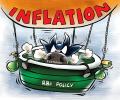
Amid a debate on the basis of a monetary policy stance, one may be curious enough to know how non-food retail inflation has behaved over the years in India. Let the eager souls catch a glimpse of facts. In the past 10 years, non-food inflation came down below 4 per cent on two occasions - pre-Covid period of 2019-20 and now in the first four months of the current financial year (FY25).

It said banks' asset quality will deteriorate across the corporate, small and medium enterprises and retail segments, leading to pressure on profitability and capital.

Terming whistleblower allegations on loan evergreening as "grossly inaccurate and baseless", Indusind Bank on Saturday admitted to have disbursed 84,000 loans without customer consent in May owing to a "technical glitch". Lending without the consent was reported by the field staff in two days, and the glitch was also rectified expeditiously, the private sector lender said in a clarification. On Friday, there was a media report about anonymous whistleblowers writing to the bank management and the RBI about BFIL, the microlending-focused subsidiary of the bank, allegedly resorting to evergreening of loans, wherein existing borrowers unable to pay dues were given new loans to present the books as clean.
